
TCIP Tea: American Production in a Fractured Global Economy
November 13, 2026
University of California, Berkeley
Berkeley, CA


Event Overview
America’s technology leadership has faced three interrelated challenges. First, China's rise as a competitor in both the development and production of a growing number of critical technologies. Second, the simultaneous weakening of the U.S. innovation ecosystem because of significant cuts in federal support for science and research, and the significant investment by China in its own research and innovation ecosystem. And third, the decoupling between U.S. research and technological leadership and the nation’s ability to scale technological breakthroughs and secure competitive and commercial production in them. The overarching question for policymakers is why this has happened and what can be done. What institutions and policies are necessary to translate our technological strengths into the competitiveness of the US as a production location for both U.S. and foreign companies, and to assure that we maintain those strengths?
TCIP Teas are in-person informal dialogues in support of economic prosperity, national security, and societal benefits.

Event Speakers

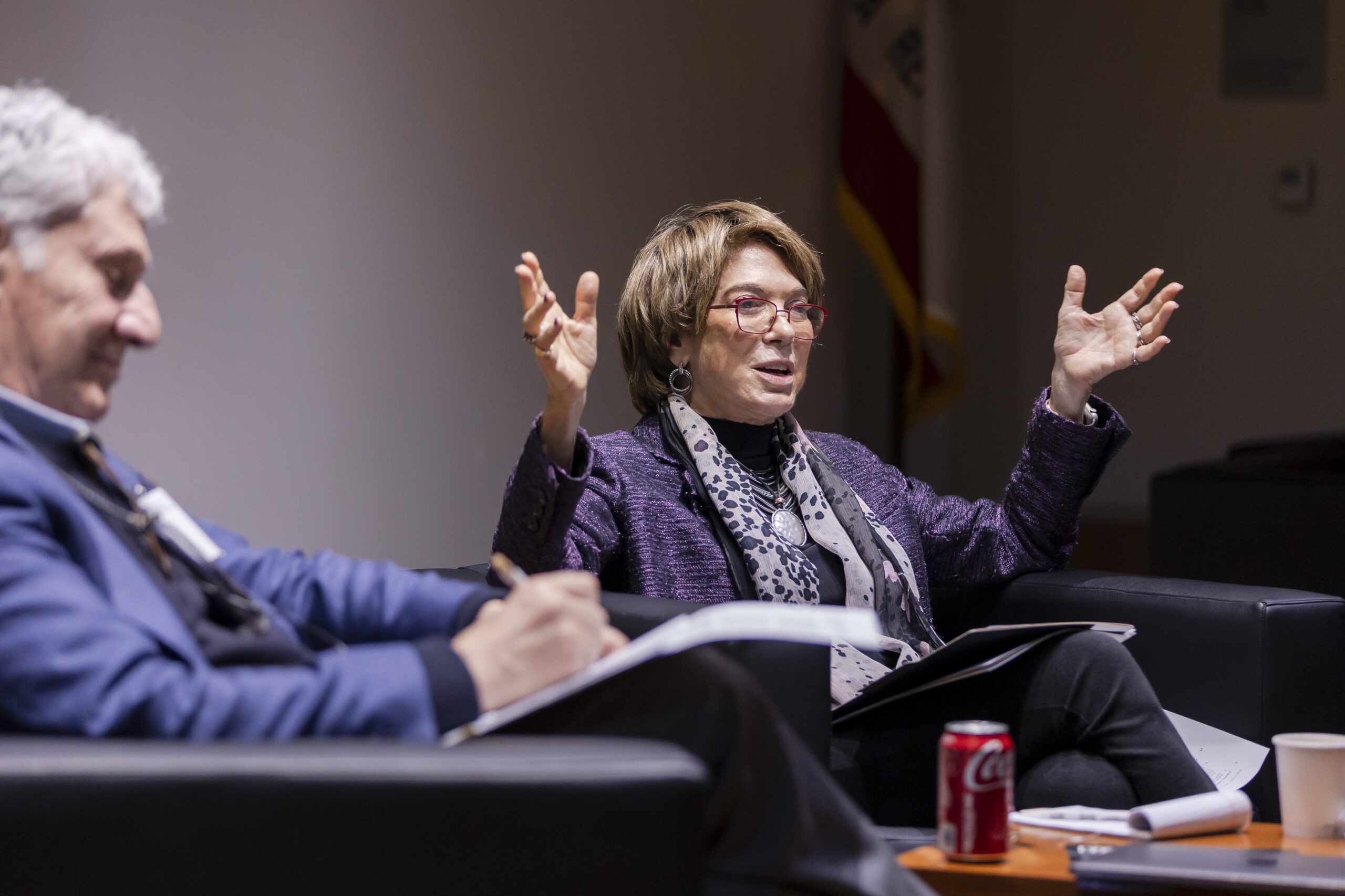
Laura Tyson
Distinguished Professor, Haas School of Business, University of California, Berkeley
Laura D’Andrea Tyson is an influential scholar of economics and public policy and an expert on trade and competitiveness who has also served as a presidential adviser. She is a Distinguished Professor of the Graduate School at the Haas School of Business, University of California, Berkeley. She chairs the Board of Trustees at UC Berkeley’s Blum Center for Developing Economies, which aims to develop solutions to global poverty.
Dr. Tyson is the former Faculty Director of the Berkeley Haas Institute for Business and Social Impact, which she launched in 2013. She served as Interim Dean of the Haas School from July to December 2018, and previously as Dean from 1998 to 2001. Dr. Tyson also held the position of Dean at London Business School from 2002 to 2006. She currently serves as a senior advisor to the Sustainable and Impact Finance Initiative at Berkeley Haas.
Dr. Tyson served as the sixteenth Chair of the White House Council of Economic Advisers (1993 – 1995), the first woman to hold that position since the Council’s establishment in 1946. Between March 1995 and December 1996, she was President Clinton’s National Economic Adviser. She was a key architect of the President’s domestic and international economic policy agenda during his first term in office As the Administration’s top economic adviser, Dr. Tyson managed all economic policy-making throughout the executive branch. She also served as a member of the President’s National Security Council and Domestic Policy Council.
From 2009 to 2011, Dr. Tyson served on President Barack Obama’s Economic Recovery Advisory Board. She was a member of the President’s Council on Jobs and Competitiveness from 2011 to 2013. Between 2011 and 2013, she also served on the U.S. Department of State Foreign Affairs Policy Board. From 2016 to 2017, Dr. Tyson served on the President’s Council of Advisors for the Science and Technology Semiconductor Working Group. Most recently, from 2020 to 2021, she was a member of French President Emmanuel Macron’s Commission d’experts sur les grands défis économiques.

John Zysman
Professor Emeritus, University of California, Berkeley and co-founder of the Berkeley Roundtable on the International Economy (BRIE)
John Zysman is Professor Emeritus at UC Berkeley and co-founder/co-director of the Berkeley Roundtable on the International Economy (BRIE). He received his B.A at Harvard and his Ph.D. at MIT. Zysman’s ongoing work covers the implications of platforms and intelligent tools for work, entrepreneurship, and international competition; and the economic challenges and opportunities of climate change and the green economy.
From these positions, Zysman has made contributions to the policy and intellectual debates, building a record of thought leadership on the global economy going back five decades. His earlier work was influential in US-Japan trade policy debates in the 1980s. More recently, Zysman has co-authored a series of papers documenting how platforms have transformed the production and distribution of goods and services; these include the well-received “The Rise of the Platform Economy,” published in Issues in Science and Technology in 2016. In addition, several recent articles, including “Unicorns, Cheshire Cats, and the Evolving Logic of Entrepreneurial Finance,” have been featured in popular media such as The Economist, The Financial Times, and the Guardian. As a director of the Work and Intelligent Tools and Systems (WITS) initiative at the Center for Information Technology Research in the Interest of Society (CITRIS), Zysman is currently exploring how the development, deployment, and consequences of technologies can be shaped by business and policy choices. In addition to his academic research, Zysman is engaged as a consultant, advisor, and board member for governments, corporations, and NGOs.